Logic Puzzles for Adults: 10 Types and How to Solve Them
A logic puzzle gives you every piece of information you need and nothing else. No trivia, no wordplay, no luck. If you reason carefully you will get the one correct answer, and you will know it is correct. That certainty is why people get hooked.
Below are ten classic types, each with a short example and its answer. Start with whichever one looks most fun, then move on to the harder ones.
1. Grid logic puzzles
The classic "who owns the fish" type. You get a list of people, a list of attributes and a list of clues, and you fill in a grid of yes and no.
Try it. Three friends, Ana, Ben and Cleo, each have one pet: a cat, a dog or a fish.
- Ana is allergic to fur.
- Ben's pet does not bark.
Answer: Ana cannot have a cat or a dog, so she has the fish. Ben's pet does not bark, so he has the cat. Cleo has the dog.
How to solve them: draw the grid even for small puzzles. Mark every "no" with an X first. When a row has only one empty cell left, that cell is a "yes", and you can X out the rest of its column.
2. Liars and truth-tellers
Some characters always lie and some always tell the truth. You have to work out who is who from what they say. These are often called knights and knaves puzzles.
Try it. Two guards, A and B. A says: "At least one of us is a liar."
Answer: If A were a liar, the statement "at least one of us is a liar" would be true, and a liar cannot say something true. So A tells the truth, which means at least one of them lies, and that must be B.
How to solve them: assume one character is a liar, follow what that means, and look for a contradiction. If you find one, the assumption was wrong.
3. Placement puzzles
Put objects on a grid so that every rule is satisfied: one per row, one per column, one per region, and no two touching. These are also known as star battle puzzles.
How to solve them: look for the smallest regions first. A region with only two cells tells you that one of those two cells is used, which often rules out the row or column they share. Also look for regions that sit entirely inside one row: that row's object must be in that region.
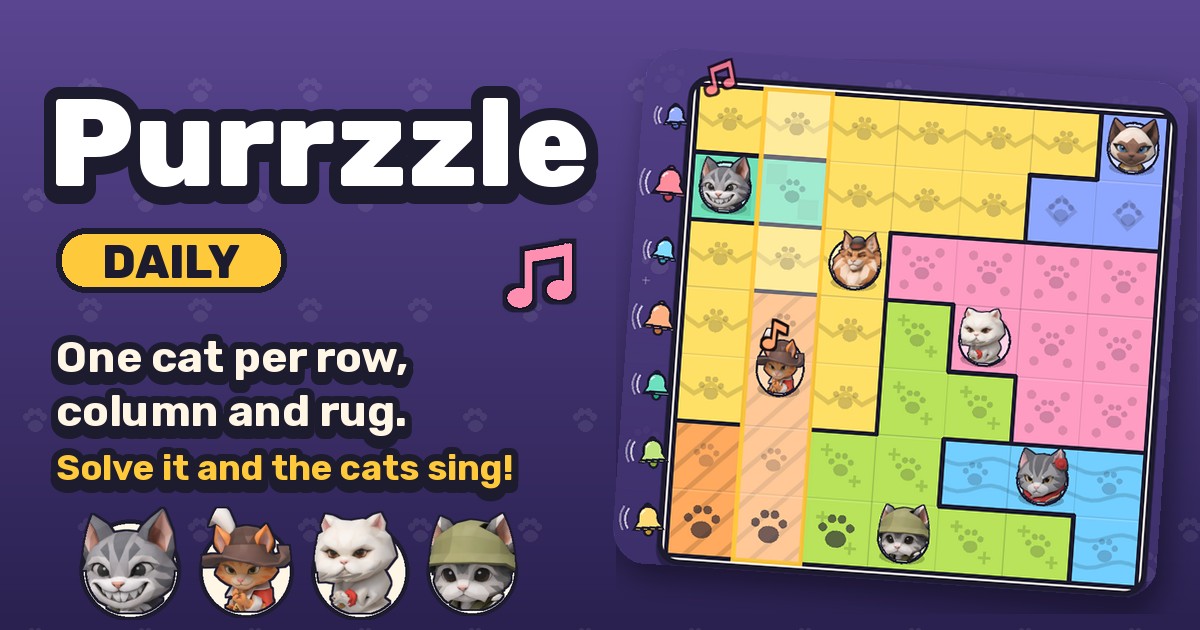
This is the puzzle behind our daily game Purrzzle, where the objects are cats on rugs.
4. River crossings
A farmer has to take a wolf, a goat and a cabbage across a river in a boat that holds the farmer plus one item. Left alone, the wolf eats the goat and the goat eats the cabbage.
Answer: Take the goat across. Go back. Take the wolf across, and bring the goat back. Take the cabbage across. Go back and get the goat.
The trick in every river crossing puzzle is the same: something has to travel backward.
5. Weighing puzzles
You have 9 coins. One is fake and lighter than the rest. You have a balance scale and can use it twice. Find the fake.
Answer: Split the coins into three groups of three. Weigh two groups. If they balance, the fake is in the third group; if not, it is in the lighter group. Now take that group of three and weigh one coin against another. Same logic: if they balance, the third coin is fake.
6. Sequence puzzles
What comes next: 1, 1, 2, 3, 5, 8, ?
Answer: 13. Each number is the sum of the two before it.
Sequence puzzles get much harder when the rule is not arithmetic. Try: O, T, T, F, F, S, S, ?
Answer: E. They are the first letters of one, two, three, four, five, six, seven, eight.
7. Number placement (sudoku and its cousins)
Fill a grid so every row, column and box contains each number once. Sudoku is the famous one, but the same idea shows up in kakuro (sums), killer sudoku (cages with totals) and futoshiki (greater-than signs between cells).
How to solve them: for every empty cell, ask which numbers are still possible. When only one is left, write it in. Experienced solvers almost never guess.
8. Path puzzles
Draw a single line that passes through every cell of a grid, or connects pairs of matching dots without crossing.
How to solve them: start at the corners and dead ends. A corner cell has only two neighbors, so the line has to enter from one and leave through the other. That decides a lot of the grid on the first move.
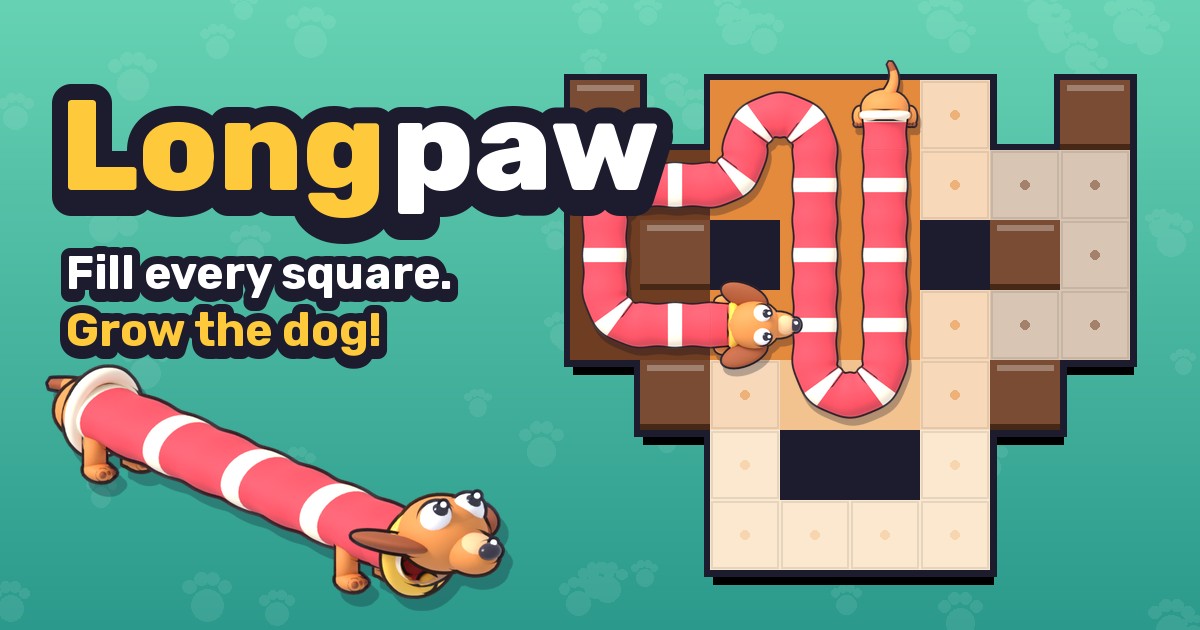
If you like these, Longpaw is a one-line puzzle with Frank, a dachshund who grows longer with every step and has to fill every square of the board in one path.
9. Lateral thinking puzzles
Strictly speaking these are riddles, but they use logic: a short, strange situation, and you have to figure out what happened. The group version is played with yes or no questions.
Try it. A man lives on the 20th floor. Every morning he takes the elevator down. Coming home, he takes it to the 10th floor and walks the rest, except on rainy days, when he rides all the way up. Why?
Answer: He is short. He can reach the 10th floor button, but not the 20th. On rainy days he has an umbrella to press it with.
More in our list of riddles with answers.
10. Door puzzles
You stand in front of several doors, and only one is safe. Each door, or the guard in front of it, gives you a clue, and some clues are lies.
Try it. Two doors. A sign on the left door says: "This door is safe and the right door is a trap." A sign on the right door says: "One of these doors is safe and one is a trap." You are told one sign is true and one is false.
Answer: If the left sign were true, the right sign would also be true, which breaks the rule. So the left sign is false and the right sign is true. Since the right sign says exactly one door is safe, and the left sign's claim is false, the right door is the safe one.
Why logic puzzles are good for adults
Logic puzzles are one of the few games where you can be sure you are right without checking an answer key. That makes them satisfying in a way word games and trivia are not.
They also fit into short gaps. A daily grid puzzle takes five to fifteen minutes, which is about the length of a coffee or a commute. People who do one every day tend to get faster in a few weeks, mostly because they start seeing patterns instead of testing every cell.
Daily logic puzzles online
Two of our games give you a new logic puzzle every day, the same one for every player, with a streak to keep.
Purrzzle Daily is a placement puzzle: put one cat in every row, every column and every rug, and no two cats may touch, not even diagonally. Every puzzle has exactly one solution, and when you finish, the solution plays a little tune.
Verity or Falsity is a liar and truth-teller puzzle. Three doors, look-alike twins in front of them, one always lies and one always tells the truth. Read what they say and pick the safe door. Five new puzzles every day.

More daily games are on the daily puzzles page.