Spot the Difference Tips: 9 Tricks to Find Every Change Faster
Spot the difference puzzles feel like a test of eyesight. They are mostly a test of method. People who are fast at them do not have better eyes; they look in a different order and know where puzzle makers like to hide things.
Here are the tricks that make the biggest difference, from simple to slightly strange.
1. Use a grid
Do not let your eyes wander. Split the picture into four quarters, or nine squares if it is busy, and check one square at a time in both pictures before moving on. Wandering eyes keep returning to the same interesting spots and skip the boring corners, which is exactly where the last difference usually is.
2. Check the edges first
Puzzle makers know that people look at the center. Edges and corners get changes that are easy to miss: a cropped object, a missing frame on a picture on the wall, a different number of fence posts. Run your eye around the border of both images before you start on the middle.
3. Look for these six kinds of change
Almost every difference falls into one of these:
- Missing: an object is gone. A button, a leaf, a window.
- Added: something new appears. Often small, like a bird in the sky.
- Color: the same object in a different color. The most common type.
- Size: something is a little bigger or smaller.
- Position or direction: an object moved, or flipped to face the other way.
- Count: three stripes become four, five petals become six.
When you get stuck, go through the list and ask each question about the picture. "Is anything flipped? Are there any counts I have not checked?"
4. Count repeated things
Stripes on a shirt, books on a shelf, spots on a dog, windows on a building. Anything repeated is a favorite hiding place for a count difference, because the eye sees "a row of books" and not "seven books".
5. Compare shapes, then colors
Your eyes notice color changes quickly but miss shape changes. Once you have found the obvious color swaps, do a second pass looking only at outlines: the curve of a smile, the angle of an arm, the shape of a cloud.
6. Move your eyes, not your head
Keep your head still and flick your eyes between the same spot in both pictures. The faster you switch, the more a change seems to "blink". This works best when the two pictures are close together.
7. The cross-eyed trick
This is the strange one, and it works surprisingly well for side-by-side pictures. Hold the screen at arm's length and slowly cross your eyes until the two pictures overlap into one in the middle. Differences shimmer or flicker in the merged image, because each eye sees something different there. It takes a few tries to get the hang of, and it does not work for pictures stacked on top of each other.
8. Take a break when you are stuck
After a minute of staring, your eyes stop seeing the picture and start seeing what they expect. Look away at something across the room for ten seconds, then come back. The last difference often jumps out right away.
9. Play a lot of them
It sounds too obvious, but pattern recognition improves with practice. After a few dozen puzzles you start to guess where the changes are before you see them, because puzzle makers have habits too.
Why we miss differences
Your brain does not see a picture in full detail. It takes in the general scene, fills in the rest from memory and expectation, and only looks closely at what seems important. Scientists call the failure to notice a change "change blindness". It is the reason you can walk past a friend's new haircut without noticing it, and it is the whole reason spot the difference works as a game.
The tips above all fight change blindness the same way: they make you look at every part of the picture on purpose, instead of trusting your brain's summary.
Spot the difference with moving pictures
Once still pictures get easy, try one that moves. Spot the Wrong Note shows two short animated scenes, one above the other, with cats and dogs in very serious situations: a family dinner, a big exam, a grand concert. You get 60 seconds to find five differences. Some are in the picture, like a missing lamp. Some are in the motion: a clock running backwards, someone nodding a beat late. With headphones on, there is a sixth bonus difference: one wrong note in the music.
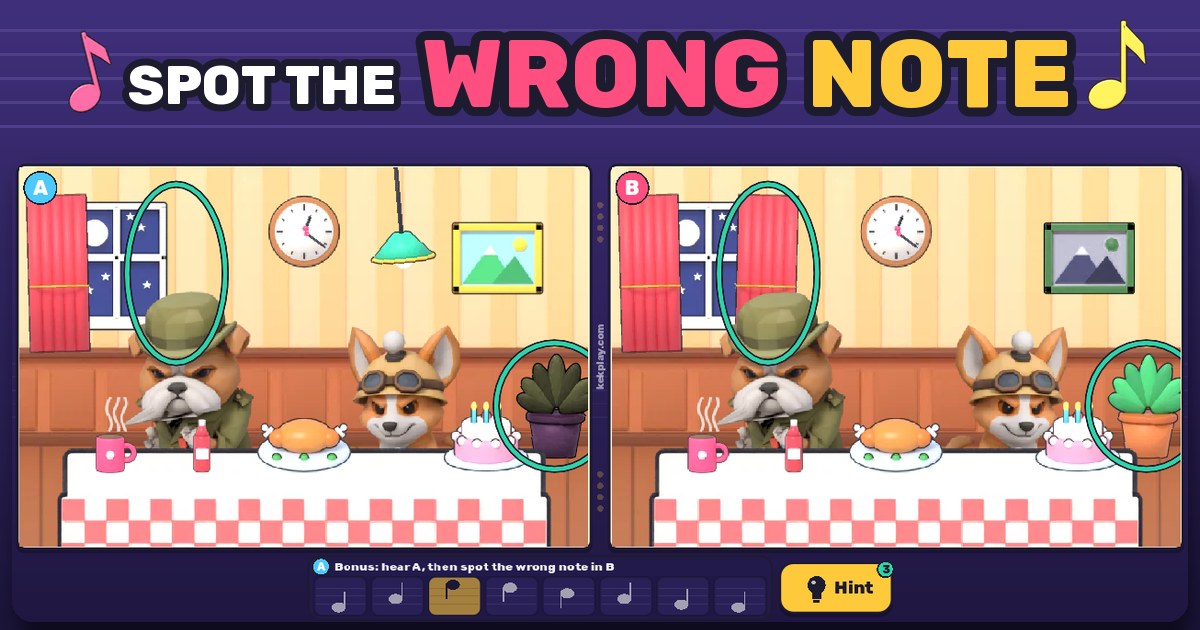
All the tips above still help, with one more: watch one part of the scene through a full loop of the animation before you move to the next. Motion differences only show at one moment of the loop.
If you like games that train your eye, Pixel Reveal paints a hidden picture pixel by pixel while you try to guess who it is. The earlier you name it, the more stars you get.