Mahjong Rules for Beginners: How to Play Step by Step
Mahjong looks harder than it is. The first time you see a table, there are 144 tiles, four walls, dice and a lot of clicking. After two or three hands it starts to feel a lot like rummy: you draw a tile, you throw one away, and you try to turn your hand into sets.
This guide covers the classic Chinese style (often called Hong Kong mahjong), which is what most people mean by "mahjong rules". At the end there is a short section on American and Japanese mahjong, and on the one-player tile matching game that also goes by the name.
The tiles
A standard set has 144 tiles. There are four copies of almost every tile.
| Group | Tiles | Count |
|---|---|---|
| Dots (circles) | 1 to 9 | 36 |
| Bamboo (sticks) | 1 to 9 | 36 |
| Characters (cracks) | 1 to 9 | 36 |
| Winds | East, South, West, North | 16 |
| Dragons | Red, Green, White | 12 |
| Flowers and seasons | 8 unique tiles | 8 |
The three suits work like the suits in a deck of cards. Winds and dragons are called honor tiles; they have no numbers, so they can only be used in sets of identical tiles. Flowers and seasons are bonus tiles: you never keep them in your hand.
A tip for the first game: the 1 of bamboo usually shows a bird, not a stick. Everyone gets caught by this once.
What you are trying to build
A winning hand has 14 tiles: four sets and one pair. A set is one of these:
- Pung: three identical tiles, like three 7 of dots or three red dragons.
- Kong: four identical tiles. It counts as one set, and you draw an extra tile to make up for it.
- Chow: three tiles in a row in the same suit, like 3-4-5 of bamboo. Honor tiles cannot make a chow.
The pair (also called the eyes) is two identical tiles.
So a finished hand might look like this: 2-3-4 of dots, 6-7-8 of characters, three East winds, three green dragons, and a pair of 9 bamboo.
Setting up
- Turn all tiles face down and shuffle them on the table with your hands. This is called washing the tiles.
- Each player builds a wall in front of them: two tiles high and 18 tiles long. Push the four walls together into a square.
- Pick a dealer, who sits in the East seat. The dealer rolls dice to choose where the wall is broken open.
- Starting from the break, players take tiles in blocks of four, going around the table, until everyone has 13. The dealer takes one extra tile and starts with 14.
- Anyone holding flowers or seasons puts them face up beside them and draws replacements from the far end of the wall.
How a turn works
The dealer starts by discarding one tile face up into the middle. Play then moves counterclockwise (to the right in most tables).
On your turn:
- Draw one tile from the wall.
- If it is a flower or season, set it aside and draw again.
- Discard one tile face up into the middle. Say its name out loud; at a real table this is the custom.
That is the whole loop. Your hand stays at 13 tiles between turns, and you are always one tile away from 14.
Claiming a discard
This is the part that makes mahjong fast. When someone discards, you can take that tile instead of waiting for your turn:
- Pung or kong: any player can claim a discard if it completes three or four of a kind with tiles from their hand. Say "pung" or "kong".
- Chow: only the player whose turn is next can claim a discard to complete a run. Say "chow".
- Mahjong: any player can claim any discard if it completes a winning hand.
When you claim a tile, lay the finished set face up in front of you, discard a tile, and play continues from you. Turns in between are skipped.
If two players want the same tile, the priority is: win first, then pung or kong, then chow.
A set you made from a claimed discard is "exposed" and stays face up. Sets you made entirely from tiles you drew stay hidden in your hand, and many scoring systems pay extra for them.
Winning a hand
You win when you complete four sets and a pair, either by drawing the last tile yourself or by claiming someone's discard. Turn your hand over and show it.
If the wall runs out and nobody has won, the hand is a draw. In most games the dealer stays the same for the next hand.
The dealer seat rotates when someone other than the dealer wins. A full game is four rounds, one for each wind, so 16 hands at minimum. Many families just play until dinner.
Scoring, the short version
Scoring is where every table has its own rules, and the full Hong Kong system takes a page of its own. The basics:
- A hand with nothing special scores the minimum. Some tables require a few points (called faan) before you are allowed to win at all, to stop people winning with junk hands.
- Hands worth more include all pungs, a hand from a single suit, sets of dragons or of your seat wind, and a hand drawn entirely from the wall without claiming any discards.
- The player who discarded the winning tile usually pays more than the others.
For a first game, skip scoring entirely. Play a few hands where winning is the only goal, then add points once everyone knows the sets.
Beginner strategy
- Throw honors early. Single winds and dragons are hard to pair. If you only have one, discard it in the first few turns, before others need it.
- Keep runs open at both ends. A 4-5 can become a chow with a 3 or a 6. A 1-2 can only use a 3.
- Do not claim everything. Every exposed set tells the table what you are building and limits what you can still do.
- Watch the discards. If three 8 of bamboo are already in the middle, stop waiting for the fourth.
American and Japanese mahjong
American mahjong uses 152 tiles, adding eight jokers. Players pass tiles to each other before play starts (the Charleston) and can only win with one of the hands printed on a card that a players' league publishes every year. There are no chows at all.
Japanese (riichi) mahjong has no flowers and adds rules for declaring that you are one tile from winning. Every winning hand needs at least one scoring pattern, which makes the strategy more complex.
Mahjong solitaire and tile matching
The mahjong you find on most game sites is a different game. It uses the same tiles, but you play alone: tiles are stacked in a shape, and you remove matching tiles that are free on at least one side until the board is clear. There are no walls, sets or discards.
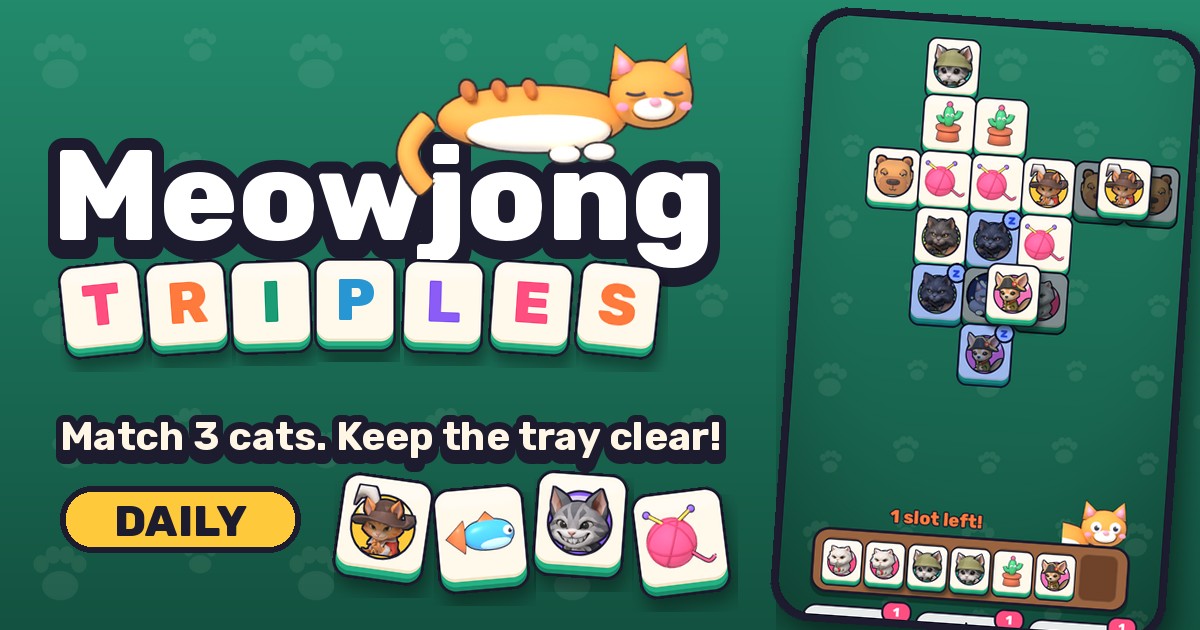
Meowjong Triples is our take on that one-player style, with cats on the tiles. Tap a free tile and it moves into a tray with seven slots. Three of the same kind clear. Fill the tray without a match and the tray cat takes a nap on it, which ends the round. Every board can be solved, and there is a new daily board each day.
If you came for card games instead, Meme Solitaire has Klondike, Spider and FreeCell, and our crazy eights rules are a good next game for a family table.