Solitaire Rules: How to Play Klondike Solitaire
When people say "solitaire" they almost always mean Klondike: seven columns of cards, a deck in the corner and four empty spaces you are trying to fill from ace to king. It is the version that came with every office computer for decades, and it is still the most played card game for one.
Here are the rules with a real deck, in the order you need them, then some strategy, then a quick look at Spider and FreeCell.
What you need
One standard 52-card deck, jokers removed. A table about the size of a placemat.
The four parts of the layout
Klondike has four areas. Everything in the rules refers to one of them.
| Area | Where | What it does |
|---|---|---|
| Tableau | seven columns in the middle | where you build and move cards |
| Stock | face-down pile, top left | cards you draw when you are stuck |
| Waste | face-up pile next to the stock | cards drawn from the stock, top one playable |
| Foundations | four spaces, top right | where you win: one pile per suit, ace to king |
Setting up
- Shuffle the deck.
- Deal seven columns from left to right. The first column gets one card, the second gets two, and so on up to seven cards in the last column. That uses 28 cards.
- Only the top card of each column is face up. The rest are face down.
- Put the remaining 24 cards face down in the top left. That is the stock.
- Leave room above the tableau for four foundation piles.
How to play
You win when all 52 cards are on the foundations, sorted by suit from ace up to king.
Building on the tableau. You can put a card on a tableau column if it is one rank lower and the opposite color. A red 9 goes on a black 10. A black 4 goes on a red 5.
Moving groups. You can move a face-up run of cards as a group, as long as the top card of the run fits where you are putting it. A red 9, black 8, red 7 can all move together onto a black 10.
Turning cards over. When you move the last face-up card off a column, flip the face-down card under it. Uncovering these hidden cards is the real goal of the game.
Empty columns. Only a king (or a run starting with a king) can go into an empty column.
Foundations. When an ace is available, move it to an empty foundation. Then build up in the same suit: ace, 2, 3 of hearts, and so on. You can also move a card back from the foundation to the tableau if that helps, though most beginners forget it is allowed.
The stock. When you run out of moves, draw from the stock onto the waste pile. The top card of the waste can be played to the tableau or a foundation. When the stock is empty, turn the waste pile over to make a new stock.
Draw 1 or draw 3
There are two common versions:
- Draw 1: turn one card at a time from the stock. You see every card, and you usually get unlimited passes through the deck. Easier.
- Draw 3: turn three cards at a time, but you can only play the top one. The cards underneath only become available when you play the top one. Harder, and closer to the original game.
Some versions limit how many times you can go through the stock (often three passes for draw 3, one pass for draw 1). Pick one and stick to it, or your win rate means nothing.
Scoring
You do not need to score to play, but if you want to:
- Standard scoring: 10 points for each card moved to a foundation, 5 points for moving a card from the waste to the tableau, 5 points for turning over a tableau card. Points are lost for moving a card back from a foundation and for passing through the deck.
- Vegas scoring: you "pay" 52 at the start and earn 5 for every card on a foundation. You are in profit if you get 11 or more cards home. Usually played draw 3 with one pass only.
Strategy that helps
Uncover the big columns first. The rightmost columns have the most hidden cards. When you have a choice of moves, pick the one that turns over a face-down card in a long column.
Do not rush cards to the foundations. A low card on a foundation is safe, but a 5 or 6 might be the only card that lets you move something else on the tableau. Move it home when it is no longer useful.
Empty a column only if you have a king to put in it. An empty column without a king waiting is a wasted space.
Pick your king carefully. If you have a red queen waiting, put a black king in the empty column.
Use the stock early. In draw 3, cycling through the stock once at the start shows you what is hidden and in which order.
Is every game of solitaire winnable?
No. Some shuffles cannot be solved no matter how well you play, because a key card is buried under cards it needs to move. Studies of Klondike with all cards visible suggest most deals can be won in theory, but with hidden cards the real win rate for good players is much lower, especially in draw 3. If you lose five games in a row, it is probably the deal and not you.
Some digital versions only give you deals that a computer has already solved, which is less frustrating.
Spider and FreeCell in one minute
Spider solitaire. Two decks, ten columns. Build down in any suit, but only a run in one suit can move as a group. A full king-to-ace run of one suit is removed from the table. Clear all eight runs to win. Play with one suit to learn, then two or four.
FreeCell. One deck, all cards face up, eight columns. Four "free cells" can each hold one card. Build down in alternating colors and move everything to the foundations. Almost every FreeCell deal can be won, so it is pure skill.
Play solitaire online
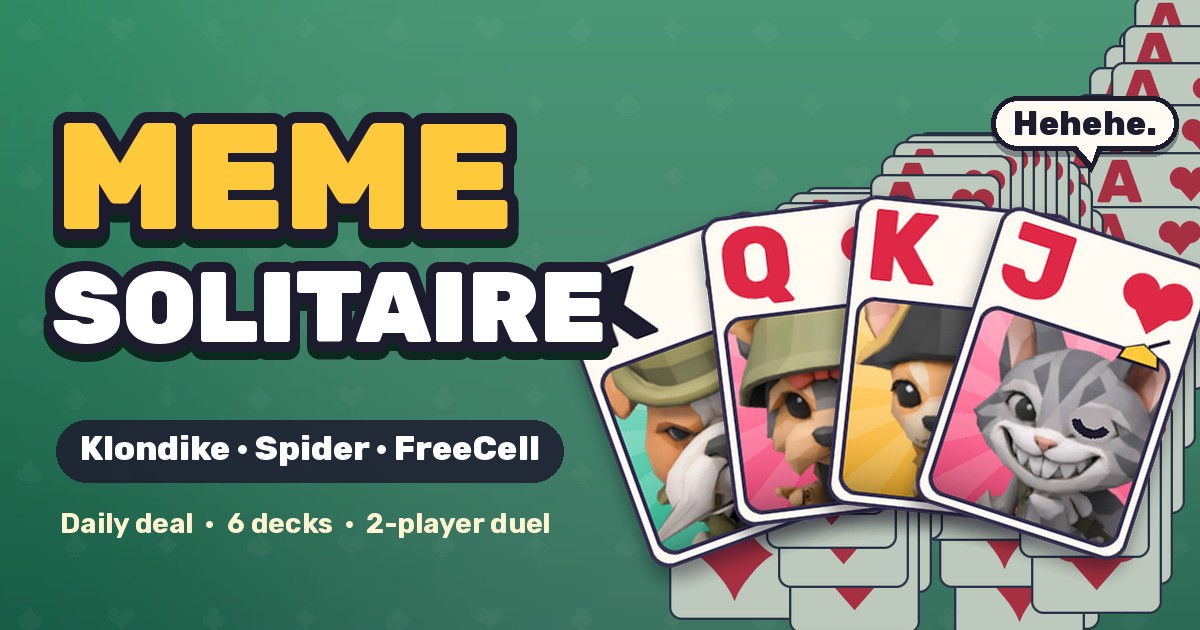
Meme Solitaire has Klondike (draw 1 or draw 3), Spider and FreeCell in one place. In Klondike, every deal is checked by a solver before you get it, so with the default setting every game can be won. There is a daily deal that is the same for everyone, unlimited undo, three hints per deal, and big cards that are easy to read on a phone. The face cards are a royal court of cats and dogs in costume, and they wink at you when you turn them over.
Prefer a card game with other people? Start with our crazy eights rules.