8 Ball Pool Rules: A Simple Guide for Beginners
Eight ball is the game on almost every bar table and in every basement with a pool table. Most arguments about it come from the fact that there are two rule sets: the official rules used in leagues and tournaments, and "bar rules" that change from one table to the next.
This guide gives you the official version first, in plain words, and flags the common bar-rule differences along the way. Agree on which ones you are using before the break and you will skip most of the arguments.
The goal
There are 15 numbered balls and one white cue ball.
- Balls 1 to 7 are solids.
- Balls 9 to 15 are stripes.
- The 8 ball is black and belongs to nobody until the end.
One player takes solids, the other takes stripes. You win by pocketing all seven of your balls and then pocketing the 8 ball in a pocket you call.
Racking
Put the balls in the triangle with the front ball on the foot spot (the dot at the far end of the table).
- The 8 ball goes in the middle of the third row.
- One corner of the back row should be a solid and the other a stripe.
- Every other ball can go anywhere.
Press the balls together so they touch, then lift the rack away carefully. A loose rack makes for a dead break.
The break
The breaking player places the cue ball anywhere behind the head string (the line across the table at the second diamond from the end where you stand).
A break is legal if you pocket at least one ball, or drive at least four balls to the cushions. If the break is not legal, the other player can accept the table as it is or rack again and break themselves.
What happens next:
- You pocket a ball on the break: you keep shooting. The table is still open. Sinking a solid on the break does not make you solids.
- You pocket nothing: your turn ends.
- You scratch on the break (the cue ball goes in a pocket): it is a foul. Your opponent gets ball in hand behind the head string in the official rules, or anywhere on the table in many leagues.
- You pocket the 8 ball on the break: in the official rules this is not a win and not a loss. You can re-rack and break again, or spot the 8 and keep shooting. In many bars, pocketing the 8 on the break is an instant win. Decide before you start.
Open table and choosing your group
After the break, the table is "open". You can hit any ball first, including mixing solids and stripes, except that the 8 ball cannot be the first ball you hit to set up a combination.
The first player to legally pocket a called ball after the break claims that group. Pocket a stripe on purpose, and you are stripes for the rest of the game.
Calling shots
In the official rules you call the ball and the pocket for every shot that is not obvious. You do not have to name cushions, kisses or combinations, only which ball goes in which pocket.
If the called ball goes in, you keep shooting. Any other balls that drop on the same shot stay down and count for whoever owns them.
Many casual games skip calling shots for everything except the 8 ball. That is fine, as long as everyone agrees.
Fouls
A foul ends your turn and gives your opponent ball in hand: they can place the cue ball anywhere on the table before their next shot. That is a big advantage, which is why fouls matter.
The common fouls:
- Scratch: the cue ball goes in a pocket.
- Wrong ball first: the cue ball hits one of your opponent's balls, or the 8 ball, before it hits one of yours.
- No rail: after the cue ball hits a legal ball, either a ball must go in a pocket or some ball (the cue ball or any object ball) must touch a cushion. If nothing hits a rail, it is a foul.
- Ball off the table: any ball that jumps off the table.
- Touching balls: touching any ball with your hand, clothes or the cue, other than the normal hit on the cue ball.
- Feet on the floor: at least one foot must touch the floor when you shoot.
In bar rules, ball in hand after a scratch is often restricted to behind the head string, and you can only shoot balls that are in front of that line. Ask before you play.
Winning and losing on the 8 ball
Once all seven of your balls are gone, the 8 ball is your target. Call the pocket, sink it, win.
You lose the game if you:
- pocket the 8 ball before clearing your group,
- pocket the 8 ball in a pocket you did not call,
- foul on the same shot where you pocket the 8 (for example, the cue ball follows it in),
- knock the 8 ball off the table.
In bar rules, scratching while shooting at the 8 ball is often a loss even if the 8 does not go in. In official rules it is just a foul and your opponent gets ball in hand.
Tips for beginners
Stop hitting so hard. Most beginners shoot at full power. A medium shot keeps the cue ball under control and makes your next shot easier.
Think one ball ahead. Before every shot, decide where you want the cue ball to stop, not just which ball you want to sink.
Do not break up clusters early. If two of your balls are stuck together, leave them until you have an easy shot that also bumps them apart.
Play safe when there is no good shot. Hide the cue ball behind one of your balls so your opponent has no clear shot. A good safety wins more games than a heroic bank shot.
Practice 8 ball on your phone
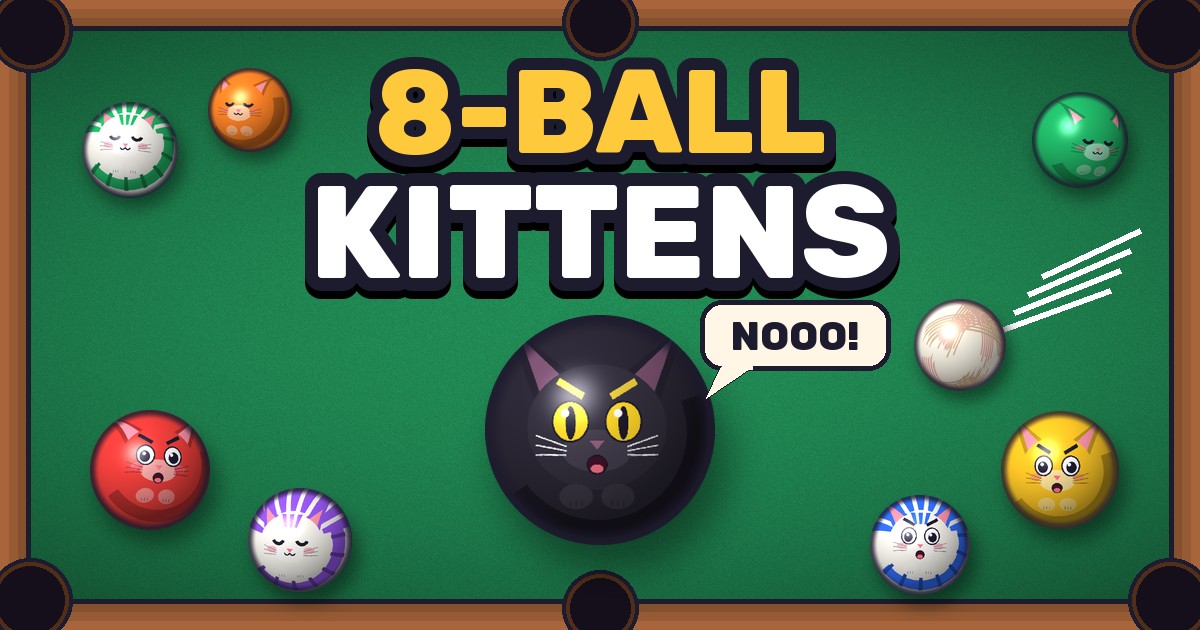
8-Ball Kittens is a free 8 ball game that runs in the browser. It uses the rules above, including open table, ball in hand after fouls and a called pocket for the 8 ball. The twist is the balls: solids are plain kittens, stripes are white tabby kittens with colored stripes, the cue ball is a ball of yarn and the 8 ball is a black cat with yellow eyes. Aim with one finger, pull back and let go. There is spin for follow, draw and english, a ladder of eight cat and dog rivals, and a daily trick shot. Two friends can also pass one phone back and forth.
Looking for more games for two? Here are our picks of 2 player games on one phone.