Four in a Row Strategy: How to Win More Games
Four in a row looks like a kids' game, and it is one. It is also a solved game: computer analysis has shown that the first player can always win with perfect play, if they start in the middle. You do not need to memorize perfect play to win more often. A handful of ideas does most of the work.
The rules in thirty seconds
The board stands upright with 7 columns and 6 rows. Two players take turns dropping one disc into any column, and the disc falls to the lowest empty spot. The first player to get four of their own discs in a line, across, up and down or diagonally, wins. If the board fills up with no line of four, it is a draw.
That is all. Everything else is strategy.
1. Take the middle column
The middle column is part of more possible lines of four than any other column. A disc there can join horizontal lines going both ways and diagonals in both directions. A disc on the edge column can only be part of lines that go one way.
If you go first, drop your first disc in the center. If your opponent took the center, take the spot right on top of it, or the columns next to it.
2. Think in threats, not in lines
A threat is an empty spot that would complete four in a row for you. The whole game is about creating threats your opponent cannot block in time.
Beginners build one line at a time and get blocked every time. Good players place discs that belong to two or three possible lines at once, so a single block cannot stop all of them.
3. Set up a double threat
The classic winning move creates two threats at once. Your opponent can only block one per turn, so you win with the other.
The most common pattern: three discs in a row on the bottom with both ends open. Your opponent blocks one end; you play the other. Experienced players never allow this, so in real games double threats usually come from a horizontal threat and a diagonal threat sharing a disc.
4. Watch what is under each empty spot
A threat only matters if a disc can actually land there. A threat on the fourth row is useless while the third row under it is empty, because nobody can play there yet.
This creates the most important rule in the game: never play directly under your opponent's threat. If they need a disc in a spot on row four, and you fill row three in that column, you just gave them the spot.
The same rule works for you. If you have a threat hanging in the air, your opponent has to avoid that column. As the board fills up, they can run out of safe moves and be forced to play under it.
5. Odd and even rows
This is the idea that separates good players from great ones.
Count the rows from the bottom, 1 to 6. If the game goes long and both players keep avoiding each other's threats, the board tends to fill column by column. When that happens, the first player usually ends up being able to claim spots on odd rows (1, 3, 5) and the second player on even rows (2, 4, 6).
So:
- If you go first, try to build threats on odd rows.
- If you go second, build threats on even rows.
A threat on the "right" row for you tends to win in the endgame on its own, because your opponent will eventually be forced to play underneath it.
6. Block early, not late
Do not wait until your opponent has three in a row to react. When they have two with plenty of open space on both sides, it is often already time to put a disc in the way. Each block also helps you if you pick a spot that builds one of your own lines.
7. Do not play the edges early
Edge columns are weak at the start. Drop discs there only to block or when the middle is full. Early edge moves give your opponent the center for free.
Is four in a row always a win for the first player?
With perfect play from both sides, yes. Researchers working independently in the late 1980s proved that the first player can force a win by starting in the middle column. If the first player starts anywhere else, the second player can force at least a draw.
Nobody plays perfectly, which is why the game is still fun. But it does mean that taking turns going first is the only fair way to play a series.
Practice four in a row online
Cats vs Dogs: Board Night has four in a row with cat and dog pieces, against a bot on three levels or against a friend on one phone. The pieces react, too: when someone wins, the losing pets panic and run away. The same game box has checkers, tic-tac-toe (classic 3x3 or a big 9x9 where you need five in a row) and Hide-and-Seek Boxes, where each player hides four pets on a grid and tries to find the other's.
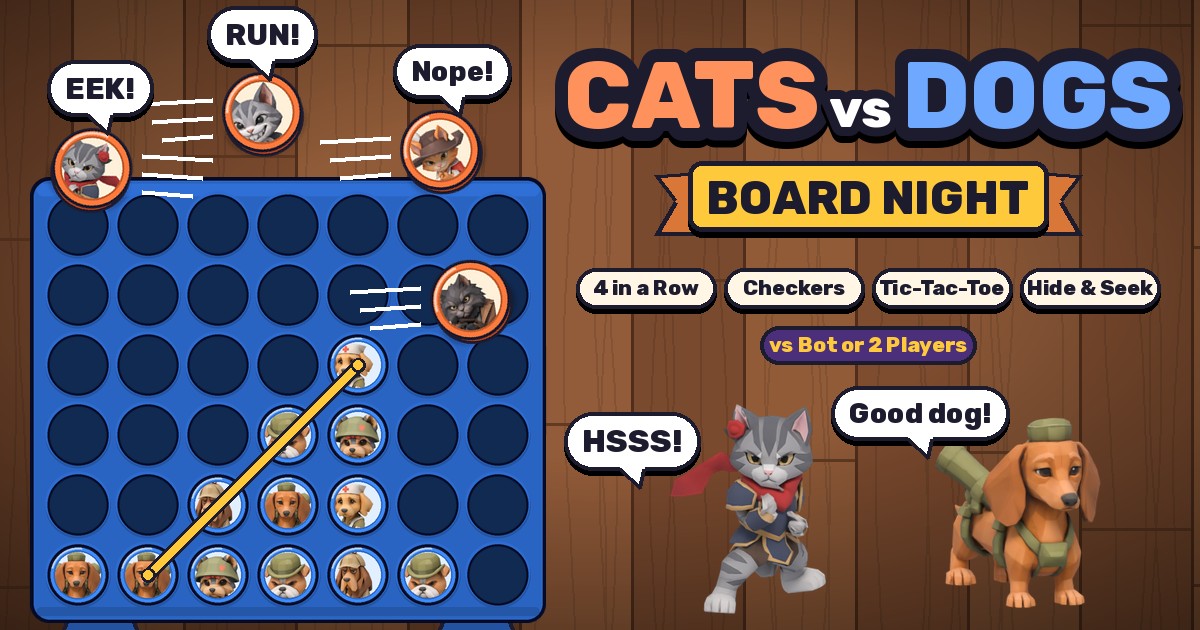
Play the bot on Hard and try the odd and even rule. It is the fastest way to see it working. For more games to play with a friend, see our list of 2 player games on one phone.