Stacking Games: Physics Tips for Taller Towers

Every stacking game asks the same question: how high can you go before it all comes down? Towers fall for a few simple physical reasons, and once you know them you can see the crash coming three pieces early.
Here are the main kinds of stacking games, the physics behind a standing tower, and tips that work in any block stacking game, with examples from our own Capybara Stack.
Kinds of stacking games
| Kind | How it works | What decides it |
|---|---|---|
| Drop and stack | A piece swings or slides above the tower, you tap to drop it | Timing |
| Physics pile | Odd shapes of different weights land on each other and wobble | Balance and order |
| Slice and stack | A slab slides across, and any part hanging over the edge is cut off | Timing, with a smaller target after every miss |
| Block removal tower | Pull blocks out of a finished tower and put them on top | Finding loose blocks |
| Color stacking | Sort rings, cups or balls so each pile is one color | Logic, no physics |
| Cup stacking | Build and take down pyramids of plastic cups, fast | Speed and hand patterns |
The first four are about physics. Color stacking games are sorting puzzles, and cup stacking is a real-world speed sport, popular in school gym classes, played with 12 cups in set patterns like 3-6-3.
Why towers fall: the center of mass
Every object has a center of mass, the point where its weight acts as if it were all in one spot. For a tower, what counts is the combined center of mass above each layer.
The rule is simple: a stack stands as long as the center of mass of everything above each contact sits over that contact. If the combined weight of the top five pieces is centered past the edge of the sixth, the top five tip over, no matter how solid the bottom looks.
- Every layer has to pass the test, not only the bottom. Towers rarely fall at the base. They break at the layer with the smallest or most off-center support.
- Overhangs are allowed. A piece can stick out past the one below as long as the weight above balances it. Stack four identical blocks at the edge of a table, offsetting them by a half, a quarter, a sixth and an eighth of a block from the top down, and the top block sits completely beyond the table edge.
Why wide and heavy goes at the bottom
A tower tips when it leans far enough that its center of mass moves past the edge of its base. How far it can lean depends on two things: how wide the base is and how high the center of mass sits.
- A wide base means the center of mass has to travel further before it passes the edge.
- A low center of mass moves sideways less for the same amount of lean.
So a short, wide tower can lean a lot and recover, while a tall, thin one tips at a small lean. Heavy, wide pieces belong at the bottom because they widen the base and pull the center of mass down. A heavy piece near the top raises it and turns every small wobble into a big one.
Shape matters: flat faces and round things
A flat face on another flat face gives a wide support area. A round object, like an orange, touches the piece below at a single point, so it has almost no base. It balances only if that point is exactly under its center, and the smallest nudge makes it roll. So:
- Turn pieces so their flattest, widest side faces down.
- Put round pieces in a dip, between two other pieces, or save them for the very top.
- Never put a flat piece on top of a round one. Under a load, a round piece acts like a ball bearing.
Timing the drop
In drop and stack games the next piece usually swings or slides above the tower. Two bits of physics help here.
First, a falling piece keeps the sideways speed it had when you let go, so a piece dropped mid-swing drifts as it falls. A swinging piece is slowest at the two ends of its swing, where it stops for an instant and turns around. Released there, it falls almost straight down. If one of those turning points is over the tower, that is the moment to drop.
Second, a wobbling tower is moving sideways too, and a piece that lands on it gets carried along. Wait until the wobble settles, or drop as the tower passes through the center. Wobbles die down by themselves as friction eats the energy, so patience is often the cheapest fix.
Tips for Capybara Stack
Capybara Stack is our calmest stacking game. A capybara relaxes in a hot spring and you drop things on its head: oranges, rubber ducks, a sleeping cat, a teapot and more, 35 items in all, each with its own shape and weight. The physics are honest, so everything above applies.
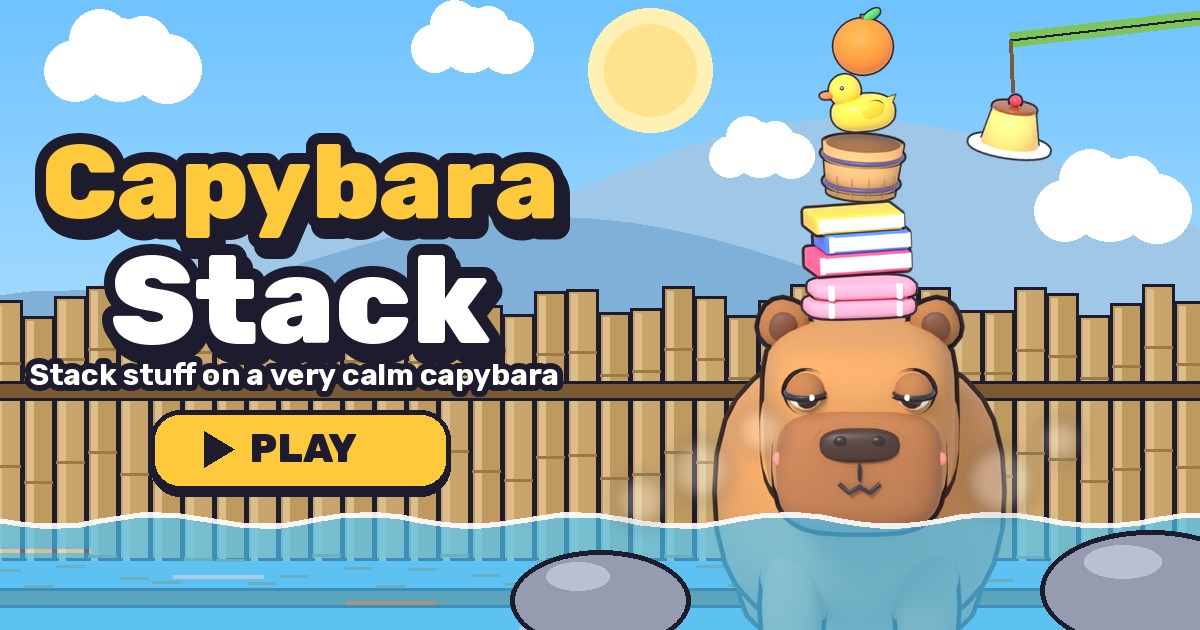
What helps most:
- Pick your foundation. You choose one of three items at the bottom of the screen. Take the widest, heaviest one for the low layers and hold round things for later.
- Rotate before you drop. Swipe the item or tap the turn button so the flat side faces down.
- Let the swing settle. The hanging item swings. Watch it and drop when it is over the tower and moving slowly.
- Count to ten. Every 10 items the capybara blinks very slowly, and that blink locks the tower below in place. A shaky piece placed just before the blink only has to survive a moment before it is safe.
- Drop between gusts. Later hot springs add wind and waves. Wait for a calm moment rather than fighting the wind.
- Shrug off one splash. Fallen items float in the water, and the run only ends after three splashes.
There are 24 levels across four hot springs, an endless mode with height records, and a Daily Tower that is the same for everyone.
Carrying a stack: inertia
Some games make you carry the tower. Here the physics is Newton's first law: an object keeps doing what it was doing unless something pushes it. When you start moving, the bottom of your stack moves first and the top lags behind. When you stop, the top keeps going. When you turn, the top swings toward the outside of the turn.
The fix is the same in every game: change speed and direction gently. Speed up slowly, slow down early and take wide turns.
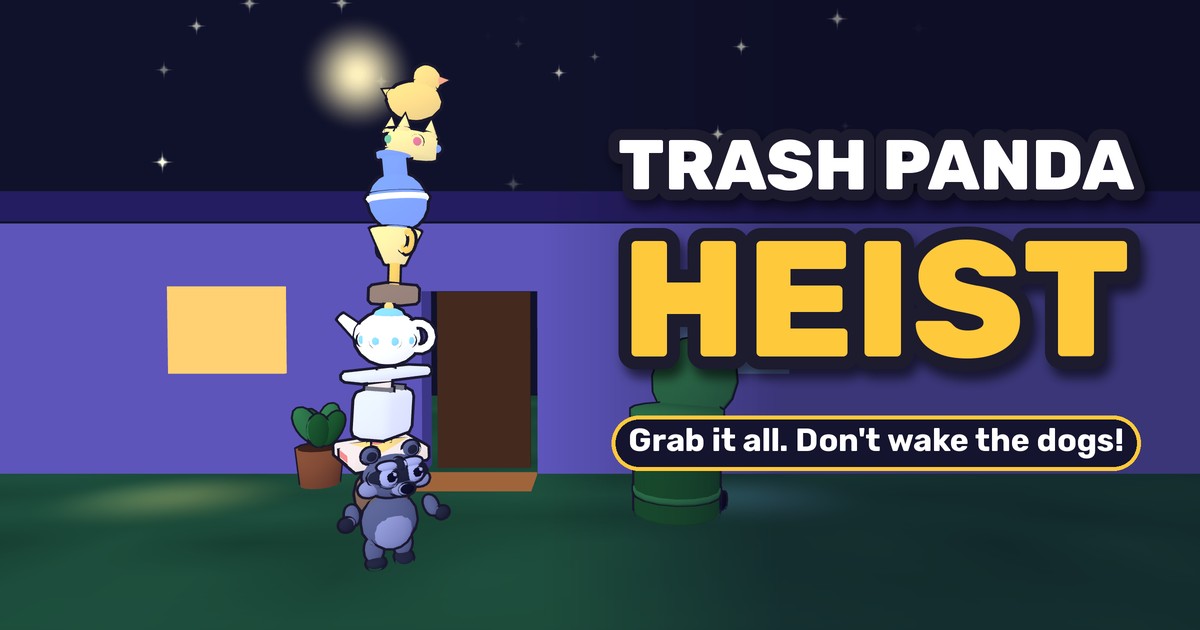
Trash Panda Heist. A raccoon steals shiny things from sleeping households, and every item lands on a wobbling pile on his back. Start, stop or turn too hard and the top of the pile crashes down. The front door is the real test, because a tall pile has to make it over the threshold.
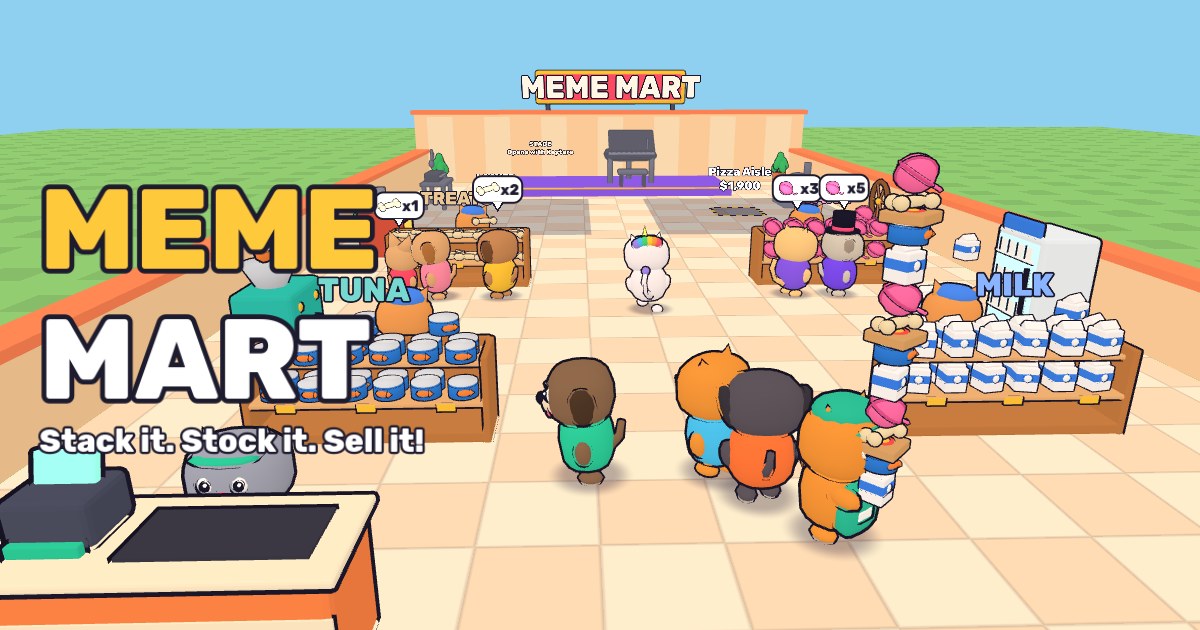
Meme Mart. A shop cat carries towers of up to 40 goods from the fridge to the shelves, and the tower bends when you turn, so wide arcs keep it together.
Order Up, Kitty! A burger is a tiny stack too: drop every layer in the middle of the bun, or it wobbles and can topple.
Block removal towers and real blocks
In tower games where you pull blocks out, look for blocks that carry no weight. Gently push a few: a loose block slides easily, a tight one is holding something up. In a full row of three, the middle block is often the safest first pick, since the two outer blocks can carry the row above on their own. Avoid taking both blocks on one side of a row, which leaves the layer above resting on a single edge.
Four paperbacks of the same size are enough to try the overhang trick on a real table.
Why one more try is so tempting
Every piece makes the tower more impressive and more fragile at the same time, so each drop matters more than the last. Then the crash is fast and funny, and the next run starts in seconds.
If knocking things over is more your style, Shelf Smash is the opposite game: three cannon shots to bring a whole shelf down. More wobbly games are on our physics games page.