Knights and Knaves Puzzles: Liar and Truth-Teller Riddles Explained

On a certain island, every person is either a knight or a knave. Knights always tell the truth. Knaves always lie. You meet a few islanders, listen to what they say about themselves and each other, and work out who is who.
That is a knights and knaves puzzle. The logician Raymond Smullyan made the setup famous in his 1978 book What Is the Name of This Book?, and it lives on in every "one guard lies, one tells the truth" riddle. Below are the rules, a method that cracks almost all of them, and seven original puzzles with answers.
The rules
- Every islander is a knight or a knave, never both and never anything else unless the puzzle says so.
- Every statement a knight makes is true.
- Every statement a knave makes is false. Not mostly false: completely false.
- There can be any number of each. Two knaves can stand side by side, and so can three knights.
Riddles with exactly one liar and one truth-teller are a special case with an extra clue built in.
The method: assume and check
- Pick one person and assume they are a knight. Their statement is now true. Follow what that means for everyone else.
- Check every other statement. If anything contradicts itself, the assumption was wrong.
- Now assume the same person is a knave, so their statement is false, and follow that the same way.
- The case that survives is the answer. If both survive, some people stay unknown.
Write K for knight and N for knave under each name as you go.
Statements worth memorizing
Some sentences show up so often that knowing them saves a lot of time. Here, A is the speaker and B is someone else.
| A says | What it tells you |
|---|---|
| "I am a knight." | Nothing. Knights say it truthfully and knaves say it as a lie. |
| "I am a knave." | Impossible. A knight would be lying and a knave would be telling the truth. |
| "B is a knave." | A and B are different kinds, but you do not know yet which is which. |
| "B and I are the same kind." | B is a knight, whatever A is. |
| "We are both knaves." | A is a knave and B is a knight. |
| "At least one of us is a knave." | A is a knight and B is a knave. |
One more trap: the opposite of "we are both knights" is "at least one of us is a knave", not "we are both knaves". When a knave says something with "and" or "both", only one part has to be false.
Seven puzzles to try
Each answer sits right under its puzzle. Cover it with your hand if you want to try first.
1. Two islanders. A says: "B is a knight." B replies: "A and I are different kinds."
Answer: both are knaves. Suppose A is a knight. Then B is a knight too, and B's claim that they differ would be a false statement from a knight. So A is a knave, and A's statement is false: B is a knave as well. B's claim is false too, since they are the same kind, and everything fits.
2. A chain of three. First A: "B is a knave." Then B: "C is a knave." Then C: "A and B are both knaves."
Answer: A is a knave, B is a knight and C is a knave. Try A as a knight: then B is a knave, so C is a knight. But C, as a knight, would be calling A a knave. Contradiction. So A is a knave, which makes B a knight and C a knave. C's claim is false because B is a knight, so it all holds.
3. Either, but not both. A claims: "Exactly one of B and C is a knight." B says: "A is a knave." C says: "B is a knight."
Answer: A is a knave, and B and C are both knights. Were B a knave, A would be a knight and C would be a knave for calling B a knight. That leaves no knights among B and C, and A, a knight, would be wrong. So B is a knight. Then A is a knave, C is telling the truth, and A's statement fails because both B and C are knights.
4. Counting heads. The first islander says: "Exactly one of us three is a knight." The second says: "Exactly two of us three are knights." The third says: "All three of us are knaves."
Answer: the first is a knight, and the other two are knaves. The third cannot be a knight, because a knight would never call himself a knave. So his statement is false, and there is at least one knight. The first two cannot both be right, so at most one of them is a knight. That gives exactly one knight in total, which is what the first one said.
5. Half an answer. A tells you: "Exactly one of us is a knight." B stays silent.
Answer: B is a knave, and A could be either. If A is a knight, A is the one knight and B is a knave. If A is a knave, the number of knights is not one, so B cannot be a knight either. Both cases work, and in both B is a knave. Saying that A is unknown is a correct answer.
6. One guard, two doors. One door leads out and the other to a trap. A single guard, a knight or a knave, stands between them. You may ask him one yes-or-no question. What do you ask?
Answer: point at the left door and ask: "If I asked you whether this door is safe, would you say yes?" A knight answers honestly about his honest answer. A knave lies about the lie he would tell, and the two lies cancel out. Either way, "yes" means the left door is safe.
7. Add a spy. Three people: one knight, one knave and one spy, who can lie or tell the truth as he likes. A announces: "I am the spy." B says: "A is telling the truth." C says: "I am not the spy."
Answer: A is the knave, B is the spy and C is the knight. A cannot be the knight, since a knight would never claim to be the spy. Suppose A is the spy and telling the truth. Then B's statement is true, so B is the knight and C is the knave. But C's "I am not the spy" would then be true, which a knave cannot say. So A is the knave and lying. B calls that lie the truth, so B lies too, and with the knave taken, B is the spy. C is the knight.
How Verity or Falsity uses the same logic
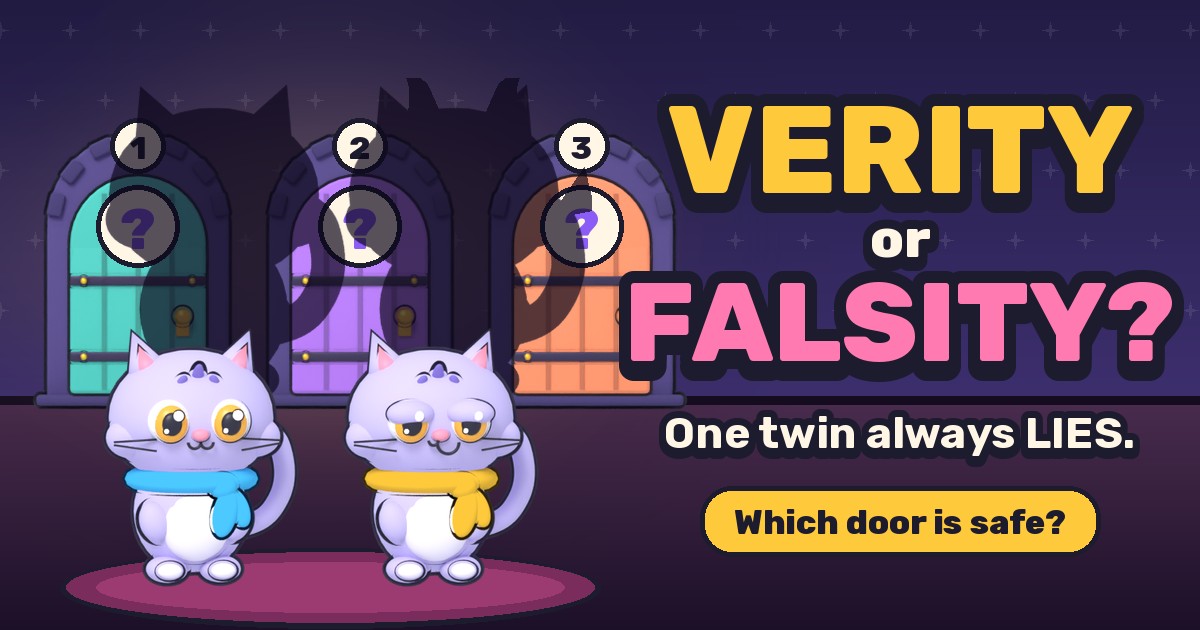
Verity or Falsity is a daily game built on these puzzles. Three doors stand in front of you, with two look-alike twin kittens beside them. One twin always tells the truth and the other always lies. Each riddle gives you two to four lines of dialogue, and you pick the safe door. Behind the wrong doors a friendly ghost waits to shout BOO.
Because there is always exactly one liar, you get a clue island puzzles do not give you: once you find the liar, the other twin is the truth-teller. Treat the first twin as honest and see whether the doors make sense. If they do not, that twin is the liar.
Five new riddles come out every day, the same for everyone, getting harder from the first to the fifth. On some nights the clock strikes midnight mid-riddle and the twins swap roles. A checker makes sure every riddle has exactly one safe door and exactly one possible liar. For practice there is the endless Hallway and a Kids mode with picture riddles.
More logic games
Our guide to logic puzzles for adults covers ten types with examples, and the list of riddles with answers ends with the classic two-guard riddle.
On kekplay, Purrzzle is a daily placement puzzle with cats, Who's Sus? Mansion Party has you find a prankster from clues, and Meme Brain is full of trick questions. More are on the puzzle games page.